
 Image 1 of 1
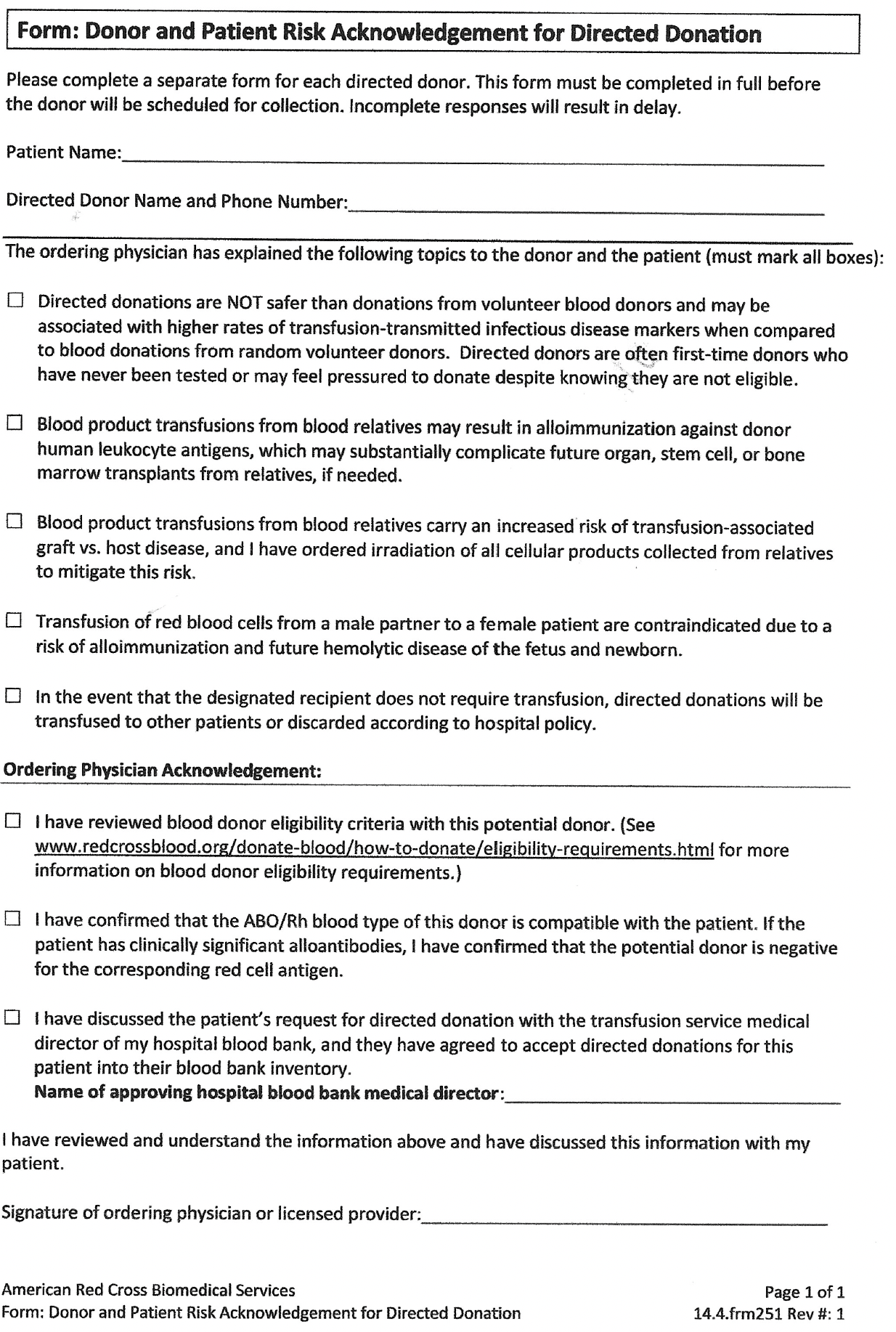
American Red Cross Donor & Patient Risk Acknowledgement for Directed Donation
$0.00
ARC is now mandating physician's to complete this form. If you're having an issue with your hospital staff and they're refusing to complete this step, we highly recommend hiring a patient advocate from Remnant Healthcare, our partners, to help you.
In some cases, American Red Cross staff may request additional medical clearance for an Autologous blood donation, but the acceptability for blood donation will be determined by the American Red Cross Regional Medical Director or designee . Orders must be received before appointments can be scheduled by the Special Collections Scheduling Team. A service charge is added to the cost of autologous blood to cover the special handling of these units. This charge may not be covered by insurance. As a representative of the transfusing facility your signature represents their agreement to receive the units ordered whether used by the intended recipient or not. The donor’s hemoglobin must be 11 gm/dL or greater.
We advise that collections be made at least 2 weeks prior to the date of need to allow for processing of the blood but may be collected up to 42 days in advance.
Contact: Special Collections Scheduling
Email: vFaxForSCS@redcross.org
Phone Number: 800-634-9069
Fax Number: 800-886-7024
Business hours: 8:00 a.m. to 5:00 p.m.
Autologous donations are blood donations that individuals give for their own use – for example, before a surgery.
Requirements for an Autologous Donation
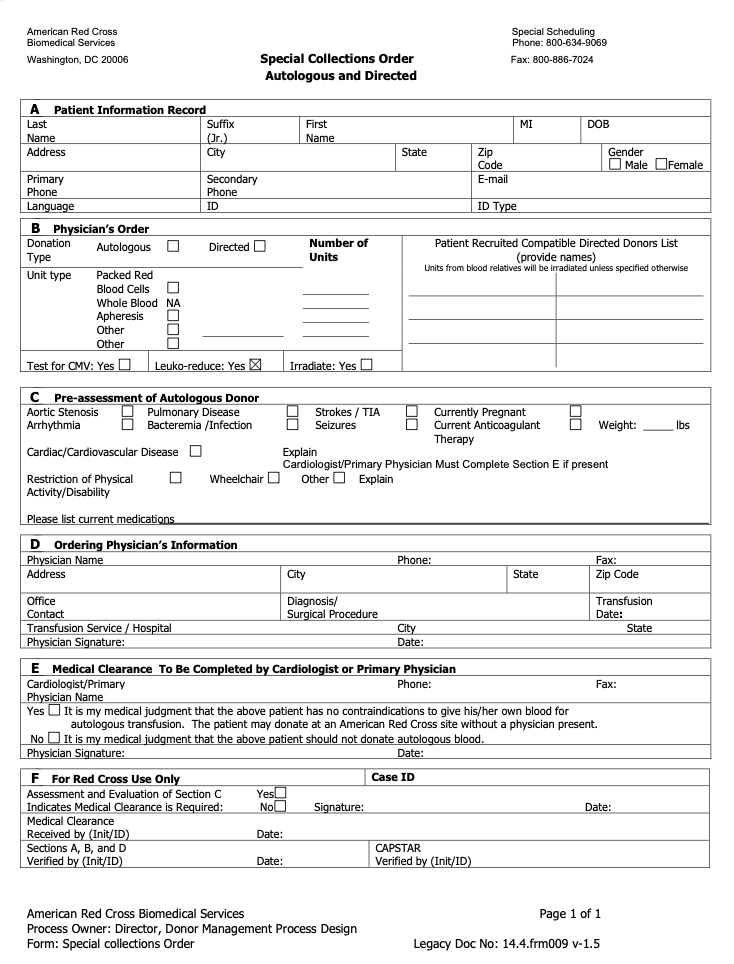
Autologous donations require a Red Cross Special Collections Order form signed by your physician which serves as a prescription for this service. The order must be received by the Red Cross several weeks prior to the anticipated need.
You or your physician can request the required Red Cross autologous order form be faxed or emailed to the physician’s office. (Contact information is listed at the bottom of the page.)
You must be in reasonably good health. You will not be allowed to self-donate if you have an active infection and you may not be allowed if you have a heart condition.
There is no age limitation for autologous donation, but you must weigh at least 110 pounds.
Unless otherwise directed by a physician, you may safely donate blood every four to seven days before your surgery if you meet the donation guidelines.
Many physicians prefer patients not have an autologous donation within 7 days of surgery.
Acetaminophen (Tylenol), aspirin and alcohol should be avoided for 48 hours before your donation.
Your hemoglobin will be checked and must be at a satisfactory level before donating or you will not be allowed to donate. A physician may prescribe iron supplements to prevent you from testing too low, especially if you have been anemic or are making more than one autologous donation.
If blood loss during your surgery is less than anticipated, transfusing the autologous blood may not be medically necessary. If the autologous blood is not used during surgery, it is discarded since current safety standards do not allow its transfusion to other patients.
A directed donation occurs when a patient's ABO and Rh compatible family members and/or friends donate blood for his or her upcoming procedure. A patient must have his/her physician submit a Red Cross Special Collections Order form for the Red Cross to collect blood from the selected donors. Once a completed, signed form is received, a specialized scheduling team will contact the donors to arrange appointments at designated collection centers and shipment to participating transfusion services.
Carefully consider the following:
There is no evidence that patients can select safer donors than the volunteer blood system provides.
All donated blood products are tested with the same tests for HIV and other infectious diseases, which further enhances the safety of the blood supply.
Social pressure associated with directed donations may compromise the reliability of the donor’s answers to health-history questions
The Red Cross accepts both directed and regular donations and encourages eligible donors to give blood for patients in need.
Contact SpecialCollections@redcross.org to determine the availability of services in your area. Include your name, phone number, transfusion facility, city and state. Alternately you can call the Special Scheduling team during normal business hours M-F at 1-800-634-9069.
ARC is now mandating physician's to complete this form. If you're having an issue with your hospital staff and they're refusing to complete this step, we highly recommend hiring a patient advocate from Remnant Healthcare, our partners, to help you.
In some cases, American Red Cross staff may request additional medical clearance for an Autologous blood donation, but the acceptability for blood donation will be determined by the American Red Cross Regional Medical Director or designee . Orders must be received before appointments can be scheduled by the Special Collections Scheduling Team. A service charge is added to the cost of autologous blood to cover the special handling of these units. This charge may not be covered by insurance. As a representative of the transfusing facility your signature represents their agreement to receive the units ordered whether used by the intended recipient or not. The donor’s hemoglobin must be 11 gm/dL or greater.
We advise that collections be made at least 2 weeks prior to the date of need to allow for processing of the blood but may be collected up to 42 days in advance.
Contact: Special Collections Scheduling
Email: vFaxForSCS@redcross.org
Phone Number: 800-634-9069
Fax Number: 800-886-7024
Business hours: 8:00 a.m. to 5:00 p.m.
Autologous donations are blood donations that individuals give for their own use – for example, before a surgery.
Requirements for an Autologous Donation
Autologous donations require a Red Cross Special Collections Order form signed by your physician which serves as a prescription for this service. The order must be received by the Red Cross several weeks prior to the anticipated need.
You or your physician can request the required Red Cross autologous order form be faxed or emailed to the physician’s office. (Contact information is listed at the bottom of the page.)
You must be in reasonably good health. You will not be allowed to self-donate if you have an active infection and you may not be allowed if you have a heart condition.
There is no age limitation for autologous donation, but you must weigh at least 110 pounds.
Unless otherwise directed by a physician, you may safely donate blood every four to seven days before your surgery if you meet the donation guidelines.
Many physicians prefer patients not have an autologous donation within 7 days of surgery.
Acetaminophen (Tylenol), aspirin and alcohol should be avoided for 48 hours before your donation.
Your hemoglobin will be checked and must be at a satisfactory level before donating or you will not be allowed to donate. A physician may prescribe iron supplements to prevent you from testing too low, especially if you have been anemic or are making more than one autologous donation.
If blood loss during your surgery is less than anticipated, transfusing the autologous blood may not be medically necessary. If the autologous blood is not used during surgery, it is discarded since current safety standards do not allow its transfusion to other patients.
A directed donation occurs when a patient's ABO and Rh compatible family members and/or friends donate blood for his or her upcoming procedure. A patient must have his/her physician submit a Red Cross Special Collections Order form for the Red Cross to collect blood from the selected donors. Once a completed, signed form is received, a specialized scheduling team will contact the donors to arrange appointments at designated collection centers and shipment to participating transfusion services.
Carefully consider the following:
There is no evidence that patients can select safer donors than the volunteer blood system provides.
All donated blood products are tested with the same tests for HIV and other infectious diseases, which further enhances the safety of the blood supply.
Social pressure associated with directed donations may compromise the reliability of the donor’s answers to health-history questions
The Red Cross accepts both directed and regular donations and encourages eligible donors to give blood for patients in need.
Contact SpecialCollections@redcross.org to determine the availability of services in your area. Include your name, phone number, transfusion facility, city and state. Alternately you can call the Special Scheduling team during normal business hours M-F at 1-800-634-9069.