
 Image 1 of 1
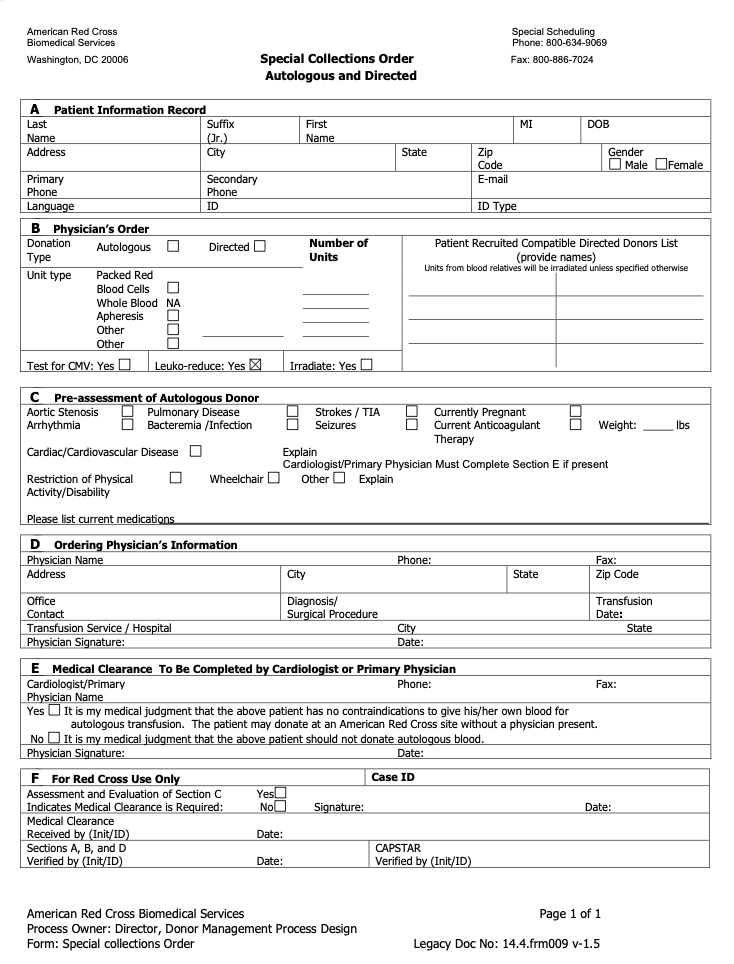
Versiti Autologous Donation Prescription Form (IL, IN, MI, OH & WI)
$0.00
www.versiti.org
The Autologous (Self) Donation Program allows patients to donate their own blood to meet the anticipated transfusion needs for planned surgeries. However, the use of autologous blood has decreased dramatically over the years due to the fact that donor screening protocols and sensitive blood tests were developed to reduce the risk of transmission of hepatitis and HIV. Collection of autologous units is no longer a standard practice.
It is the responsibility of the patient’s physician and the medical staff at Versiti to determine whether the patient’s health will permit them to donate safely.
As soon as possible after the decision for surgery is made, please review the information with the patient and complete the Autologous Donation Prescription Form. Autologous donations are drawn at the following sites:
Illinois: Aurora, Tinley Park, Crystal Lake, DeKalb, Joliet, Winfield, Naperville and Highland
Indiana: all donor centers
Michigan: Grand Rapids, Kalamazoo, Saginaw, Traverse City, Livonia and Midland Dow Diamond
Ohio: Mill Run Center
Wisconsin: all donor centers
Nearly anyone who is scheduled to undergo a planned surgical procedure that may require the transfusion of blood is eligible to participate in the Autologous Donor Program. However, for the safety of autologous donors, certain guidelines must be followed.
There are several contraindications to autologous donation:
Unmanaged aortic stenosis
Heart attack (myocardial infarction) within the last six months
Hemoglobin less than 12.5 g/dL for females and 13.0 g/dL for males
High blood pressure greater than 180/100 mm Hg
Active infection with or without ongoing antibiotic treatment
Seizures within the last two months
Patient’s weight less than 110 lbs.
Note: In the event the autologous patient is not able to understand the donation procedure or reliably answer the medical history questionnaire given before donation, a legal representative of the patient must be available to provide medical information and/or donation authorization in case of need.
The patient may donate in an interval of three days between donations prior to surgery, as long as allogeneic hemoglobin level is met. The donation must be made at least seven days prior to the date of surgery. On the day of donation, the patient will be given a mini-physical, including a medical history, blood pressure, pulse, temperature, and a small sample of blood to test hemoglobin. If the patient passes this mini-physical and meets the eligibility criteria, a unit of blood will be drawn. This process takes approximately one hour.
Although rare, a donor may experience an adverse reaction during blood collection or within a few hours after blood is drawn. These reactions include but are not limited to: discomfort, swelling and bruising at the needle site; fainting and convulsions; injury to blood vessels or nerves; infection; and local blood clot. Some reactions may preclude any further autologous donations. IN this and other instances, blood from the community blood supply may be needed for the patient’s surgery. To prevent reactions, it is recommended that the donor has something to eat within two hours preceding donation.
A special autologous label with information linking the unit to the patient is affixed to the blood bag. Components requested by the physician retain the special autologous labeling information, and upon meeting testing and processing requirements, are delivered to the hospital where the surgery is scheduled.
As the Autologous Donor Program requires the services of many trained professionals, special handling of the blood, and additional paperwork, the processing charges for each autologous unit are higher than for other donated blood. Since the blood components requested by the patient’s physician are held for the exclusive use of the patient, these charges are assessed even if the blood is never transfused. There are additional charges for shipping the units out of Versiti’s service area. Health insurance (including Medicare) may not cover processing fees for autologous blood and/or additional processing, as needed.
Drawing of autologous units to be transfused to hospitals outside of Versiti’s service area must be approved by Versiti Hospital Services. Whenever autologous blood needs to be shipped to other blood centers, patients are responsible for making arrangements in advance with these centers to ensure they will accept the shipments.
Note: Autologous units testing reactive for infectious disease markers will be shipped depending on acceptance by the physician and transfusing facility. If not accepted, these units will be discarded.
www.versiti.org
The Autologous (Self) Donation Program allows patients to donate their own blood to meet the anticipated transfusion needs for planned surgeries. However, the use of autologous blood has decreased dramatically over the years due to the fact that donor screening protocols and sensitive blood tests were developed to reduce the risk of transmission of hepatitis and HIV. Collection of autologous units is no longer a standard practice.
It is the responsibility of the patient’s physician and the medical staff at Versiti to determine whether the patient’s health will permit them to donate safely.
As soon as possible after the decision for surgery is made, please review the information with the patient and complete the Autologous Donation Prescription Form. Autologous donations are drawn at the following sites:
Illinois: Aurora, Tinley Park, Crystal Lake, DeKalb, Joliet, Winfield, Naperville and Highland
Indiana: all donor centers
Michigan: Grand Rapids, Kalamazoo, Saginaw, Traverse City, Livonia and Midland Dow Diamond
Ohio: Mill Run Center
Wisconsin: all donor centers
Nearly anyone who is scheduled to undergo a planned surgical procedure that may require the transfusion of blood is eligible to participate in the Autologous Donor Program. However, for the safety of autologous donors, certain guidelines must be followed.
There are several contraindications to autologous donation:
Unmanaged aortic stenosis
Heart attack (myocardial infarction) within the last six months
Hemoglobin less than 12.5 g/dL for females and 13.0 g/dL for males
High blood pressure greater than 180/100 mm Hg
Active infection with or without ongoing antibiotic treatment
Seizures within the last two months
Patient’s weight less than 110 lbs.
Note: In the event the autologous patient is not able to understand the donation procedure or reliably answer the medical history questionnaire given before donation, a legal representative of the patient must be available to provide medical information and/or donation authorization in case of need.
The patient may donate in an interval of three days between donations prior to surgery, as long as allogeneic hemoglobin level is met. The donation must be made at least seven days prior to the date of surgery. On the day of donation, the patient will be given a mini-physical, including a medical history, blood pressure, pulse, temperature, and a small sample of blood to test hemoglobin. If the patient passes this mini-physical and meets the eligibility criteria, a unit of blood will be drawn. This process takes approximately one hour.
Although rare, a donor may experience an adverse reaction during blood collection or within a few hours after blood is drawn. These reactions include but are not limited to: discomfort, swelling and bruising at the needle site; fainting and convulsions; injury to blood vessels or nerves; infection; and local blood clot. Some reactions may preclude any further autologous donations. IN this and other instances, blood from the community blood supply may be needed for the patient’s surgery. To prevent reactions, it is recommended that the donor has something to eat within two hours preceding donation.
A special autologous label with information linking the unit to the patient is affixed to the blood bag. Components requested by the physician retain the special autologous labeling information, and upon meeting testing and processing requirements, are delivered to the hospital where the surgery is scheduled.
As the Autologous Donor Program requires the services of many trained professionals, special handling of the blood, and additional paperwork, the processing charges for each autologous unit are higher than for other donated blood. Since the blood components requested by the patient’s physician are held for the exclusive use of the patient, these charges are assessed even if the blood is never transfused. There are additional charges for shipping the units out of Versiti’s service area. Health insurance (including Medicare) may not cover processing fees for autologous blood and/or additional processing, as needed.
Drawing of autologous units to be transfused to hospitals outside of Versiti’s service area must be approved by Versiti Hospital Services. Whenever autologous blood needs to be shipped to other blood centers, patients are responsible for making arrangements in advance with these centers to ensure they will accept the shipments.
Note: Autologous units testing reactive for infectious disease markers will be shipped depending on acceptance by the physician and transfusing facility. If not accepted, these units will be discarded.